
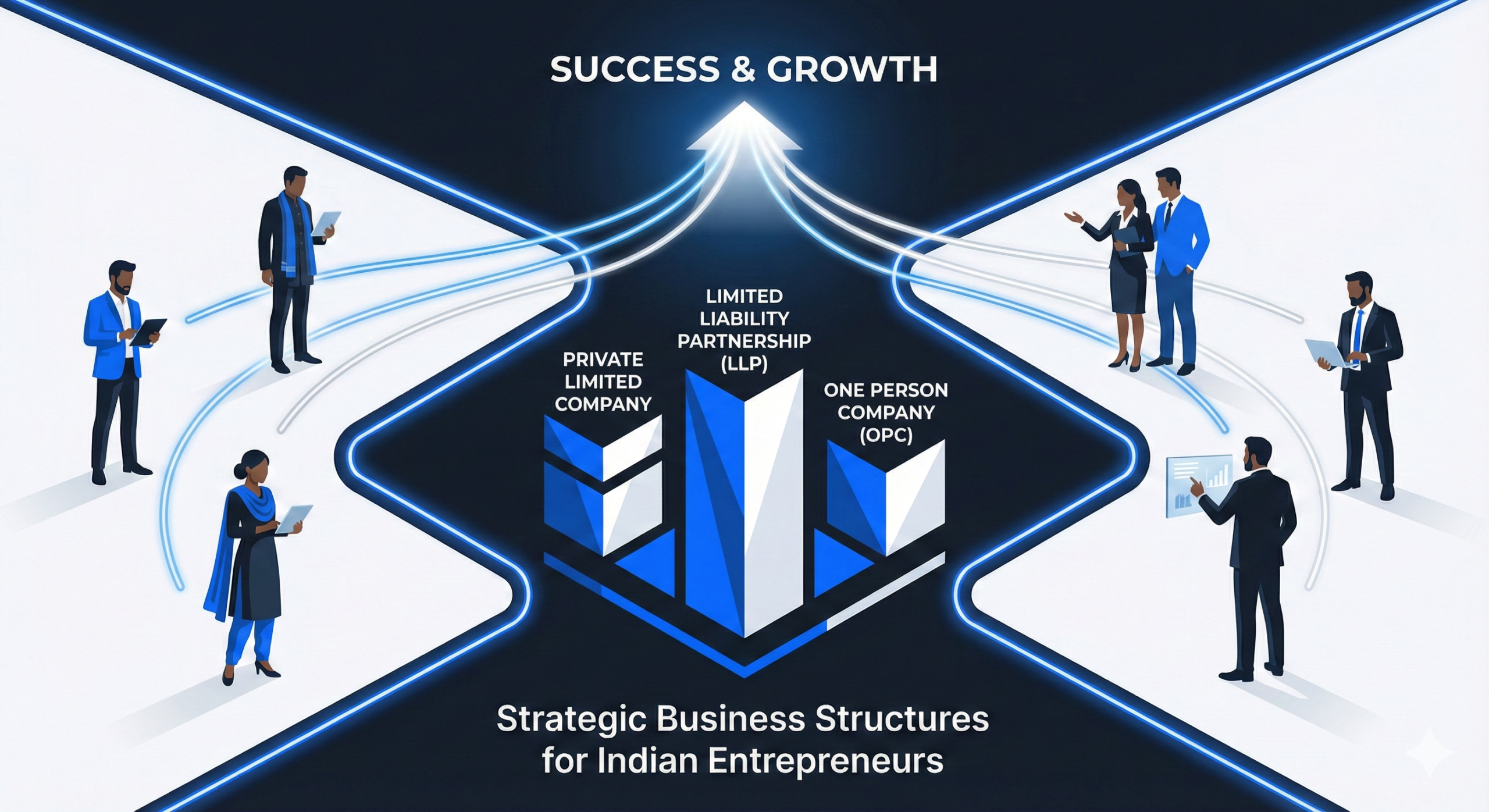
How to Choose the Right Business Structure in India: Pvt Ltd vs LLP vs OPC (2025 Guide)
How to Choose the Right Business Structure in India: Private Limited Company vs LLP vs OPC
Embarking on an entrepreneurial journey in India is an exhilarating prospect, filled with innovation, dedication, and the promise of growth. However, before your groundbreaking ideas can take flight, a fundamental decision looms large: choosing the right business structure. This initial choice isn’t merely a formality; it’s a strategic cornerstone that will influence everything from your legal liabilities and fundraising capabilities to compliance burdens and long-term scalability. In the vibrant and complex Indian business landscape, three primary structures frequently come into focus for budding entrepreneurs and growing enterprises: the Private Limited Company (Pvt Ltd), the Limited Liability Partnership (LLP), and the One Person Company (OPC).
Many first-time business owners often grapple with this decision, feeling overwhelmed by the jargon and the potential implications. Should you opt for the robust, investor-friendly Private Limited Company? Or does the flexible, less compliant Limited Liability Partnership suit your collaborative venture better? Perhaps the simplicity and single-founder focus of a One Person Company is the ideal starting point for your solo endeavor? Each structure comes with its own unique set of advantages, disadvantages, and suitability based on your specific business goals, risk appetite, capital requirements, and future vision. A misstep here can lead to unnecessary complexities, higher costs, or missed opportunities down the line. Conversely, a well-informed decision can lay a strong, resilient foundation for sustained success and growth.
This comprehensive guide aims to demystify the intricacies of these three popular business structures in India. We’ll delve deep into their core characteristics, explore their benefits and drawbacks, and provide a detailed comparative analysis. More importantly, we’ll equip you with a practical framework and key considerations to help you confidently navigate this crucial decision. Our goal is to empower you with the knowledge needed to align your chosen business structure perfectly with your entrepreneurial aspirations, ensuring your venture is set up for optimal performance and compliance from day one, without any salesy pitches, just clear, expert insights.
Understanding the Fundamentals: Key Factors to Consider
Before diving into the specifics of each business structure, it’s crucial to understand the foundational factors that should guide your decision. These elements are interconnected and will significantly impact which structure is most appropriate for your unique business idea and operational style. Approaching this decision with a clear understanding of these considerations will streamline your thought process and lead to a more effective choice.
Liability Protection
One of the most critical aspects to consider is the extent of liability protection offered by a business structure. As an entrepreneur, you face inherent risks. Do you want your personal assets (like your home or savings) to be at risk if your business incurs debts or faces legal challenges? Structures offering ‘limited liability’ separate your personal finances from your business finances, protecting your assets. Conversely, ‘unlimited liability’ means your personal assets can be used to settle business debts. This single factor often steers entrepreneurs towards corporate structures.
Number of Partners/Shareholders
The composition of your founding team plays a significant role. Are you a solo entrepreneur with no immediate plans for co-founders? Or are you starting a venture with one or more partners? Some structures have minimum and maximum requirements for the number of individuals involved. An OPC, by its very definition, is for one person, while an LLP or Private Limited Company requires at least two. Future plans for bringing in more partners or shareholders should also be anticipated here.
Capital Requirements & Funding
How much capital do you need to start your business, and how do you plan to raise it? Some structures are inherently more attractive to external investors (like angel investors or venture capitalists) due to their robust legal framework and ease of equity dilution. If your business model requires significant initial investment or you foresee seeking external funding for rapid expansion, this factor will heavily influence your choice. Also consider the minimum capital requirements for formation, if any.
Compliance & Regulatory Burden
Every business structure comes with a set of statutory compliances, annual filings, and regulatory obligations. Some are simpler and require fewer compliances, leading to lower operational costs and less administrative hassle. Others, particularly those designed for higher growth and investor appeal, come with stricter and more frequent reporting requirements, which can be resource-intensive. Your comfort level with administrative tasks and your budget for professional services should be weighed here.
Scalability & Growth Plans
Where do you envision your business in 5 or 10 years? Do you plan to expand rapidly, potentially go public, or attract large investments? Some structures are inherently more scalable and adaptable to significant growth than others. For instance, converting an OPC to a Private Limited Company is possible but involves steps; starting with a structure that accommodates your long-term vision can save time and effort later. Consider your long-term goals for market reach, employee growth, and potential for mergers or acquisitions.
Private Limited Company (Pvt Ltd): The Gold Standard for Growth
The Private Limited Company is arguably the most popular and widely recognized business structure in India, especially among startups aiming for significant growth, external funding, and a professional corporate image. Governed by the Companies Act, 2013, it strikes a balance between robust legal framework and operational flexibility, making it a preferred choice for a diverse range of businesses, from technology startups to manufacturing units.
Key Features and Benefits
A Pvt Ltd company offers ‘limited liability’ to its shareholders, meaning their personal assets are protected from business debts and legal obligations. This separation of personal and business finances is a major draw. It has a perpetual succession, meaning the company’s existence is independent of its owners; it continues even if shareholders change or pass away. This structure allows easy transferability of shares, making it attractive for investors and facilitating changes in ownership. Pvt Ltd companies are also highly regarded by banks and financial institutions, making it easier to secure loans and credit. Crucially, they are the preferred vehicle for attracting angel investors, venture capitalists, and private equity funds, as they can issue equity shares and facilitate easy stake dilution.
Ideal for Whom?
A Private Limited Company is ideal for ambitious startups and businesses with high growth potential that foresee needing external funding. If your business model requires significant capital injection, plans for rapid expansion, or intends to attract institutional investors, the Pvt Ltd structure provides the necessary legal and operational framework. It’s also suitable for businesses that want to build a strong brand image, convey credibility to customers and partners, and scale operations nationwide or even globally. Businesses with two or more founders who want clear roles, responsibilities, and defined shareholdings also find this structure highly beneficial.
Compliance and Disadvantages
While offering numerous advantages, a Pvt Ltd company comes with a relatively higher compliance burden compared to LLPs or OPCs. It requires mandatory annual filings with the Ministry of Corporate Affairs (MCA), conducting annual general meetings (AGMs), maintaining detailed statutory registers, and adhering to strict accounting standards. The formation process is more intricate and requires more documentation. There’s also a higher initial cost for registration and ongoing compliance. For small businesses with limited operations or those not seeking external funding, this extensive compliance can feel burdensome and costly, potentially diverting resources from core business activities. The strict regulatory environment demands professional assistance for ongoing compliance, which adds to operational overheads.
Limited Liability Partnership (LLP): The Hybrid Advantage
The Limited Liability Partnership (LLP) was introduced in India to provide a hybrid structure, combining the best features of a traditional partnership firm and a private limited company. It offers the flexibility of a partnership while providing the protective shield of limited liability, making it a highly attractive option for professional services firms, consultants, and ventures with multiple partners seeking a simpler compliance regime.
Key Features and Benefits
Like a Private Limited Company, an LLP provides ‘limited liability’ protection to its partners. This means that a partner’s personal assets are not at risk for the debts or liabilities of the LLP. However, unlike a company, an LLP has fewer compliance requirements, translating into lower administrative costs and less paperwork. The formation process is simpler and quicker than a Pvt Ltd company. It has perpetual succession, ensuring its existence is independent of its partners. An LLP agreement, which governs the rights and duties of partners, provides immense flexibility, allowing partners to define their contributions, profit-sharing ratios, and management roles with greater ease than in a company structure. Furthermore, there is no mandatory audit requirement for LLPs with an annual turnover below Rs. 40 lakhs or a capital contribution below Rs. 25 lakhs, reducing financial burden for smaller ventures.
Ideal for Whom?
LLPs are particularly well-suited for professional service providers such as consultants, chartered accountants, lawyers, architects, and IT professionals who typically operate with multiple partners. It’s an excellent choice for small to medium-sized enterprises (SMEs) that have two or more founders, require limited liability, but prefer a simpler governance structure and fewer compliance obligations than a Private Limited Company. If your business is collaborative in nature and doesn’t foresee needing significant external equity funding (as LLPs cannot issue equity shares), an LLP can offer the perfect blend of operational flexibility and legal protection. It’s also suitable for family businesses looking for a structured approach without the stringent regulations of a company.
Compliance and Disadvantages
While LLPs offer reduced compliance compared to Pvt Ltd companies, they still have annual filing requirements with the MCA, including statements of accounts, solvency, and annual returns. There are penalties for non-compliance, so professional guidance is often recommended. A significant disadvantage of an LLP is its limited ability to raise equity funding from external investors. Unlike Private Limited Companies, LLPs cannot issue shares, making them less attractive to venture capitalists and angel investors who typically seek equity stakes. This limits the scalability and growth potential for businesses that rely heavily on external capital. While easier to manage than a company, it still involves more formalities than a traditional partnership. Conversion from an LLP to a Private Limited Company, though possible, involves a separate set of procedures and costs, which might be a consideration for businesses with long-term aspirations for substantial external investment.
One Person Company (OPC): Empowering Solo Entrepreneurs
The concept of a One Person Company (OPC) was introduced in India by the Companies Act, 2013, to provide a structured and legally distinct entity for individual entrepreneurs. Prior to this, a single founder either operated as a sole proprietorship (with unlimited liability) or had to involve a second person to form a private limited company. OPCs bridge this gap, offering the benefits of corporate status to solitary business owners.
Key Features and Benefits
The primary advantage of an OPC is ‘limited liability’ protection. As a sole proprietor, your personal assets are always at risk, but with an OPC, your liability is limited to the extent of your capital contribution, safeguarding your personal wealth. An OPC also provides a distinct legal identity separate from its owner, enhancing credibility in the market. It enjoys perpetual succession, meaning the business continues even if the original owner is incapacitated or passes away, as a nominee director takes over. This structure offers a relatively simpler compliance regime compared to a Private Limited Company, requiring fewer board meetings and filings. It allows for easier access to bank loans and credit facilities due to its corporate identity and limited liability status, often perceived as more credible than a sole proprietorship.
Ideal for Whom?
An OPC is perfectly suited for solo entrepreneurs, freelancers, consultants, and small business owners who want to formalize their operations and gain the benefits of limited liability without the complexities of managing multiple partners or shareholders. It’s an excellent stepping stone for individuals who are starting a venture on their own and prefer to retain complete control over their business decisions. If you’re a single founder looking to separate your business assets from personal assets, enhance your business’s credibility, and potentially scale up in the future without immediate plans for co-founders or external equity funding, an OPC can be an ideal choice. It offers a structured way to operate while keeping administrative overheads manageable for a single-person operation.
Compliance and Disadvantages
While simpler than a Private Limited Company, an OPC still has mandatory annual compliance requirements with the Ministry of Corporate Affairs (MCA), including filing annual returns and financial statements. It needs to appoint a nominee director during incorporation, who would take over in case of the original director’s death or incapacity. A significant limitation is that an OPC cannot raise equity funding from external investors by issuing shares, similar to an LLP. This restricts its ability to attract venture capital or angel investment, limiting rapid scalability if substantial capital is needed. Furthermore, there are specific thresholds: if an OPC’s paid-up capital exceeds Rs. 50 lakhs or its average annual turnover for the immediately preceding three consecutive financial years exceeds Rs. 2 crores, it ceases to be an OPC and must compulsorily convert into a Private Limited Company or a Public Limited Company within six months. This mandated conversion can be a complex and costly process if not anticipated, making it less suitable for businesses with very high growth projections from inception.
Comparative Analysis: Pvt Ltd vs LLP vs OPC at a Glance
Choosing the right business structure in India often boils down to a clear understanding of how Private Limited Companies, LLPs, and OPCs differ across key operational and strategic dimensions. A side-by-side comparison can illuminate which structure aligns best with your specific business needs and long-term aspirations. While we’ve discussed each in detail, let’s look at a consolidated view for a quicker understanding.
Capital & Investment
For capital and investment, a **Private Limited Company** stands out as the most robust option. It has no minimum capital requirement and, crucially, can issue equity shares, making it the preferred vehicle for attracting significant external investment from angel investors, venture capitalists, and private equity firms. This ease of fundraising is its major competitive edge for scalable ventures. An **LLP** also has no minimum capital requirement but cannot issue equity shares, limiting its ability to raise capital from traditional equity investors. Funding is typically through partner contributions or debt. An **OPC**, designed for solo entrepreneurs, also has no minimum capital requirement and cannot issue equity shares, making it unsuitable for equity-based external funding. Its capital usually comes from the single director/shareholder’s contribution or debt.
Management & Decision-Making
**Private Limited Companies** have a more formalized management structure, requiring a minimum of two directors and specific board meeting protocols. Decisions are made by the board of directors and shareholders, adhering to corporate governance norms. An **LLP** offers significantly more flexibility in management. The LLP agreement dictates the roles, responsibilities, and decision-making processes among partners, allowing for a customized and less formal approach. An **OPC** offers ultimate control to the sole director/shareholder, who makes all decisions. While simple, it lacks the checks and balances of a multi-person board, though this isn’t a concern for a single-person entity.
Taxation Implications
**Private Limited Companies** are taxed as separate legal entities at a corporate tax rate, which can be beneficial for profits retained within the company for reinvestment. Dividends distributed to shareholders are also taxed. **LLPs** are taxed as partnership firms, meaning the income is taxed at the firm level, and partners are not taxed again on their share of profits (subject to certain conditions). This can offer tax efficiency in certain scenarios. **OPCs** are taxed similar to Private Limited Companies as corporate entities, subjected to corporate tax rates. It’s always advisable to consult with a tax expert to understand the specific tax implications for your business model under each structure, as tax laws are subject to change and vary by specific circumstances.
Ease of Formation & Closure
The **Private Limited Company** has a more complex and time-consuming formation process, involving more documentation and adherence to the Companies Act. Its winding up (closure) process is also more intricate. An **LLP** offers a comparatively simpler and quicker registration process than a Pvt Ltd company, with fewer formalities. Its closure process is also less complex than a company. An **OPC** has a relatively straightforward formation process, similar in complexity to an LLP, and is designed for single individuals. The closure process for an OPC, while simpler than a Pvt Ltd, still involves formal steps under the Companies Act.
Practical Steps to Make Your Decision
Choosing the right business structure is a pivotal decision that should not be taken lightly. It requires careful consideration of various factors specific to your business and personal circumstances. Instead of rushing, follow a structured approach to ensure your decision aligns perfectly with your entrepreneurial vision and practical needs. Here are practical steps to guide you through this critical process.
Assess Your Business Goals
Start by clearly defining your short-term and long-term business goals. Are you looking to build a small, sustainable lifestyle business, or do you have ambitions for rapid scalability and market dominance? If your goal is to grow into a large enterprise, attract substantial investments, and potentially go public, a Private Limited Company might be your best bet from the outset. If your aim is to provide professional services with a few partners, prioritizing flexibility and lower compliance, an LLP could be more suitable. For solo ventures focused on controlled growth and personal control, an OPC might be ideal. Your goals dictate the fundamental requirements your structure must meet.
Evaluate Your Risk Appetite
How comfortable are you with personal financial risk? If you prefer to keep your personal assets completely separate from your business liabilities, a structure offering limited liability (Pvt Ltd, LLP, OPC) is non-negotiable. Sole proprietorships, while simple, expose your personal assets to business debts. Even within limited liability structures, consider the nature of your business: does it involve high-risk activities that could lead to significant financial or legal exposure? A robust corporate structure often provides stronger legal shields.
Consider Your Team Structure
The number of founders and partners you have, or plan to have, is a crucial determinant. If you’re going solo, an OPC is tailor-made for you. If you’re collaborating with one or more partners, an LLP or a Private Limited Company becomes necessary. Think about the dynamics of your team: do you need a highly flexible agreement (LLP) or a more formal, hierarchical structure for management (Pvt Ltd)? Future expansion plans to bring in more partners or shareholders should also be anticipated here.
Plan for Future Growth
Think beyond immediate needs. While an OPC or LLP might be simpler to start, consider the implications if your business grows significantly. Will you need to attract external investors? Will you want to bring in more directors or shareholders? Converting from an OPC or LLP to a Private Limited Company is possible but involves time, cost, and legal procedures. Choosing a structure that can comfortably accommodate your projected growth path can save you hassle and resources in the long run. If funding is key to your growth, lean towards structures preferred by investors.
Seek Professional Advice
While this guide provides comprehensive information, the specific nuances of your business and the ever-evolving regulatory landscape in India make professional advice invaluable. Consult with a legal expert, chartered accountant, or company secretary who specializes in business registrations. They can assess your unique situation, understand your long-term vision, and provide tailored recommendations, ensuring you comply with all regulations and select the most advantageous structure for your specific circumstances. An expert can also help you understand the tax implications of each structure and potential future changes.
Conclusion
Choosing the right business structure in India—be it a Private Limited Company, a Limited Liability Partnership, or a One Person Company—is a foundational decision that will profoundly impact your entrepreneurial journey. There is no universally